
"A talking cube"a white cube with a mouth, white background", image generated with Midjourney.
On November 29, 2022, ChatGPT, a service offered by OpenAI, appeared on our screens and transformed our relationship with artificial intelligence (AI) and, more broadly, with information. From a vague, distant, and emerging concept, AI became real. The combination of the extreme simplicity of written dialogue in the form of a natural conversation, the “chat,” and the instantaneity of the responses provided by the underlying model, the “GPT,” fascinates seasoned engineers and the least attentive students alike. All other interfaces with physical or digital knowledge bases suddenly seem cumbersome. We feel as if we were projected into a future that once seemed so distant, accustomed as we are to the sporadic trickle-down of laboratory inventions into the consumer market. Yet the service only took about ten months to attract more than 1.8 billion users. This immediate integration of new technology into our daily lives, this direct transition from research centers to our desks, is quite unusual. The sensation of instant power provided by ChatGPT is fascinating and frightening. It captured the media’s attention, abruptly awakened political, economic, and cultural elites. And it amused students who now have access to a wordsmith that saves them from tedious hours of writing. From the cover of Time magazine of the February 27 – March 06, 2023 (Double Issue), featuring a screenshot asking ChatGPT what it thinks of the headline composed by human journalists to the Italian government’s decision to cut off access to the service within its territory, and the strike declared in May 2023 by the American writers’ union, the world is in complete turmoil. Everyone is caught off guard, and no one knows what to do. But everyone is testing it, and no one is letting go. A single conversation with the language robot makes us dependent, already torn between the desire for abstinence and the intoxication of power.
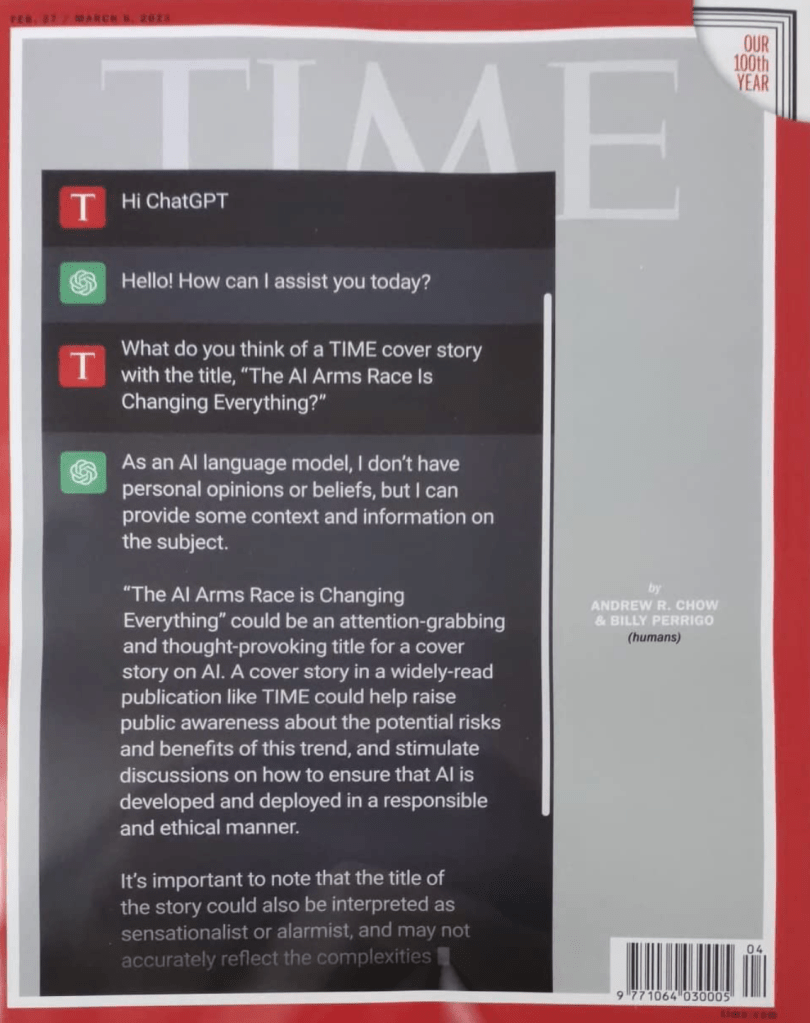
The Chat of ChatGPT: The Disguise of AI.
This near-instant adoption is not due to AI itself but rather to a refined understanding of optimizing our interactions with complex systems. This relationship involves constant negotiation with the core of technical systems, which takes place at an interface—a possible meeting point midway between human cognition and the binary electrical processes of machines. In the case of ChatGPT, the work on interaction focused on inputting text and displaying responses. The mode of textual conversation, or “chat,” is a stroke of genius by the interface designers. It is a very familiar interaction that requires no learning: people already exchange thousands of messages via their smartphones this way. The understanding of how to interact is immediate.
Moreover, a minimalist aesthetic approach is adopted. The screen is cleared of all other interaction prompts: no menu, no message, no advertisement, no alternative path. Only the input field is present on the page. It does not contain instructions like “ask me something” or “describe what you are looking for,” phrases that would reinforce the system’s function. No. The prompt is of a different order: “send a message.” This call to action is remarkable because it immediately suggests to the user how to interact—exchanging messages as they would with any of their human contacts. This places the user somewhere beyond a traditional search engine.
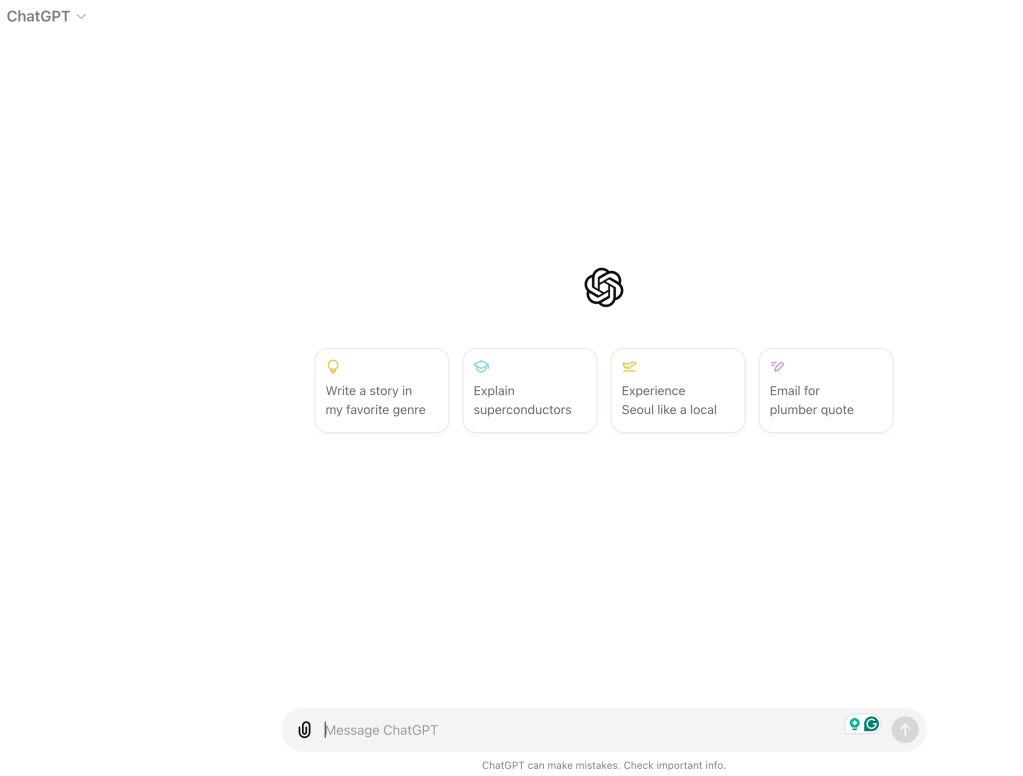
ChatGPT interface, July 30. 2024.
Finally, the response to the message doesn’t arrive all at once. Still, it is written gradually, token by token, imitating and reinforcing the feeling of a human brain thinking about the correct formulation. These interaction elements, which have nothing to do with AI, create an interface that almost disappears in favor of its primary function. The user’s attention is entirely captured by the response window, a central, practically bare space whose meticulous design resembles the pure lines of a Dieter Rams creation. All focus is dedicated to the fascination elicited by the response, perfectly composed and often pertinent, unfolding word by word in the form of a magical spectacle. The oracle is at work.
These few moments during which users watch the system in action provide them time to imagine the power activated so simply and the linguistic treasures extracted that now belong to them. After a few keystrokes, hours of work seem to materialize instantly, generating a sense of satisfaction induced by the system’s quality output, often better than what one could have produced with the same allocated time. But it doesn’t stop there. The interface designers further disguised the machine by allowing it to imitate social phrasing between questions and answers. For instance, in response to the prompt: “Write a description of a lamb for a kid who has never seen one in his life,” the system starts with: “Sure! I’d be happy to describe a lamb for you,” before launching into a detailed description. It demonstrates conversational analysis skills that subtly take into account the elements of human conversation. Completing the “adjacent pair”1 of turns between the user and the system mimics conversational norms and smooths the exchange.
This imitation could have caused an equally instant rejection if it was imperfect. And this is indeed another key to the system’s phenomenal success: the “just right” imitation, which is neither ironic, nor obsequious, nor comic, nor mechanical. It is benevolent. In this aspect, it might seem like a more user-friendly search engine—a dematerialized public writer. But it is much more than that. ChatGPT touches our relationship with our bodies, from our hands that write (or wrote?) to our eyes that now witness lines composing themselves, and our brains, which we suddenly begin to doubt, are impenetrable and dominant over machines. It affects our relationship with time. We no longer know exactly where to place the future, whether we are consciously building it or it is being imposed on us. The apparent omniscience of AI interfaces and the well-calibrated way of querying them by modeling prompts to get appealing answers ultimately question our limitations in producing original, curious, spontaneous, complex, or simply beautiful signs for ourselves beyond immediate vanity and artificial emptiness.
Activities General ISDT Module personal thoughts Reflective practices Search and Social Media Marketing
Footnotes:
- Schegloff, E. A., & Sacks, H. (1973). Opening up Closings. Semiotica, 8(4). https://doi.org/10.1515/semi.1973.8.4.289 ↩︎
 Laurent Bolli - Blog